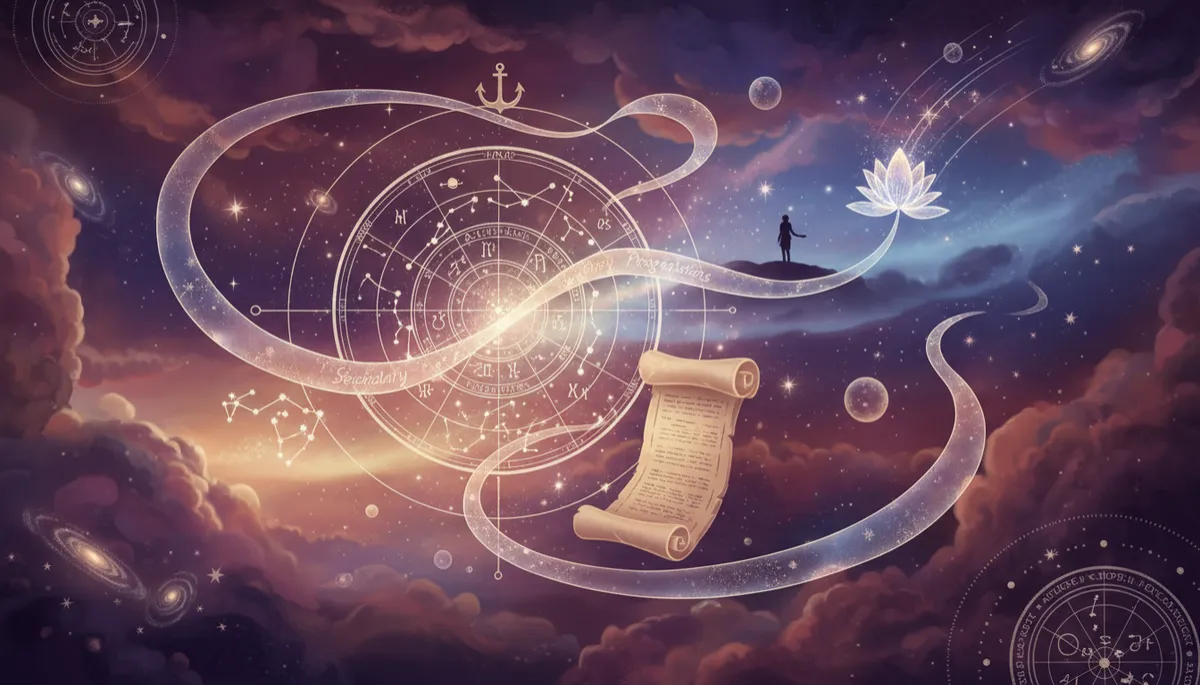
Understanding Secondary Progressions in Astrology
Astrology, Secondary Progressions, Beginner’s Guide
Secondary Progressions in Astrology: Your Inner Story Unfolding
If your birth chart is the cosmic snapshot of who you were the moment you arrived on Earth, secondary progressions are like a time‑lapse movie of who you are becoming. In this guide, we’ll gently walk through what secondary progressions are, how they differ from your natal chart, and why they can feel so eerily accurate when you’re going through big inner changes in your life.
Your Natal Chart: The Cosmic “Birth Photo”
Before we step into secondary progressions, let’s ground ourselves in what you may already know: your natal chart. Think of your natal chart as a cosmic birth photo. It captures the exact arrangement of planets and signs at the moment you took your first breath. That chart doesn’t change. The Sun will always be in the same sign, the Moon in the same sign, the Ascendant in the same sign as long as we are talking about that birth moment.
Your natal chart describes your core wiring: your temperament, your instinctive reactions, your basic needs in love and work, your natural strengths and blind spots. If someone asks, “Who am I really, underneath everything?” the natal chart is the map we look at first. It’s the blueprint you came in with, the original script of your soul’s intentions in this lifetime.
What Are Secondary Progressions?
Now, imagine that instead of a single birth photo, you had a whole album that showed you growing up: first steps, first day of school, awkward teenage years, the moment you started to really feel like yourself. That album is what secondary progressions are like in astrology. They don’t replace your natal chart; they animate it, showing how you unfold over time on an inner, emotional, and psychological level.
Technically, secondary progressions use a simple symbolic timing rule: one day after your birth equals one year of your life. So, when an astrologer looks at your life at age 25, they look at the planetary positions 25 days after you were born. Those “moved‑forward” positions are your progressed planets. They show how the original birth chart has evolved inside you, like rings inside a tree that reveal different seasons you’ve lived through.
Progressions vs. Transits vs. Your Natal Chart
It can help to compare secondary progressions to other astrological tools you might have heard of. We’ve already said your natal chart is your lifelong blueprint. Then there are transits, which track where the planets are in the sky right now and how they interact with your natal planets. Transits tend to show outer events and circumstances: the job offer, the move, the new relationship, the breakup, the surprise opportunity or challenge that comes from the outside world.
Secondary progressions, on the other hand, describe inner weather. They reflect the seasons of your heart, the shifts in your priorities, the way your emotional landscape changes over years. You could say:
- Natal chart: Who you are at your core.
- Transits: What’s happening around you.
- Secondary progressions: How you are growing on the inside.
When you’ve outgrown an old dream, when your taste in partners suddenly shifts, when you quietly realize, “I’m not that person anymore,” it’s often your progressed chart that explains why. It shows the subtle but powerful evolution of your inner life that may not be obvious to anyone else at first, yet feels undeniable to you.
The Progressed Sun: Long Seasons of Becoming
The progressed Sun moves very slowly, spending about 30 years in each sign. It describes long chapters of your life story, where your overall focus and sense of purpose gradually shift. You don’t wake up one morning and feel completely different; instead, over a few years, your priorities quietly rearrange themselves until you realize you’re walking a new path.
For example, imagine you were born with the Sun in Cancer, a sign associated with home, family, and emotional security. In your early life, you might be very focused on belonging, nurturing others, and building a safe nest. When your progressed Sun moves into Leo, you may slowly feel called to step out of the background and be seen. You might start craving creative expression, taking up acting, performing, or simply sharing more of your heart openly. It’s not that you stop being a Cancer at your core; it’s that your journey is now asking you to develop Leo‑type qualities as part of your evolution.
When people say, “I feel like I’m entering a new chapter of my life,” the progressed Sun is often changing signs or making a major aspect in their progressed chart. It’s the slow turning of the seasons of your soul, asking you to grow in new directions while still honoring who you’ve always been.
The Progressed Moon: Your Emotional Weather
If the progressed Sun is like the season, the progressed Moon is the day‑to‑day weather. It moves much more quickly, spending about 2½ years in each sign and around 27–28 years to go all the way around the chart. The progressed Moon describes what your heart is hungry for right now, what feels comforting, and where your emotional attention is drawn.
You might notice that for a couple of years you’re obsessed with learning, reading, and talking to new people (a progressed Moon in Gemini), and then, almost without realizing it, you shift into a quieter phase where you crave privacy, deep bonding, and emotional depth (a progressed Moon in Scorpio). From the outside, your life might look similar, but your inner world has changed direction. You’re asking different questions, feeling different needs, and that’s exactly what the progressed Moon describes.
Why Secondary Progressions Matter So Much
Many people first discover secondary progressions during a time of inner crisis or major transition. Maybe you’ve felt like you’ve “gone off script” from the person you thought you were supposed to be. Maybe you can’t explain why the things that used to make you happy suddenly feel empty, or why you’re drawn to completely different people, careers, or lifestyles. This is where progressions become deeply validating and healing.
Progressions show that your growth is not random. They reveal that your soul has been quietly, consistently unfolding along a meaningful path. When you see your progressed chart, you can often say, “Oh, that’s why I felt that way at that time.” The timing of your inner shifts lines up with the movements of your progressed planets in a way that can feel almost magical, yet also deeply grounding. You’re not “too much,” “too late,” or “falling behind.” You’re simply in a new season of your story.
They matter because they help you:
- Honor your changing needs instead of forcing yourself to stay the same.
- Understand long emotional cycles so you don’t panic when you’re in a more introspective or uncertain phase.
- Make choices that match your current season instead of clinging to old versions of yourself that you’ve outgrown.
A Simple Real‑World Example
Let’s say you were born with a natal Sun in Virgo, practical and detail‑oriented, and a natal Moon in Capricorn, focused on responsibility and achievement. For much of your early life, you might feel driven to work hard, be useful, and prove yourself. You pride yourself on being reliable. Emotions are something you manage quietly in the background while you keep everything running smoothly for others.
In your late twenties, your progressed Moon moves into Pisces, a sign that is sensitive, imaginative, and deeply emotional. Suddenly, you might find yourself crying at movies, feeling overwhelmed by work demands, or craving more time for art, music, or spirituality. You might wonder, “What is wrong with me? I used to be so strong and composed.” But nothing is wrong. Your soul is simply asking for more softness, more compassion, more space to feel. Your progressed Moon in Pisces is inviting you into a chapter where emotional healing and creativity matter as much as productivity and success.
Seeing this in your secondary progressions can be such a relief. Instead of judging yourself, you can say, “Of course I feel this way. I’m in a Pisces Moon phase. I’m meant to be gentler with myself right now.” That awareness alone can be profoundly empowering.
How to Start Exploring Your Own Progressed Chart
You don’t need to be a technical astrologer to begin working with secondary progressions. Many astrology websites and apps can calculate your secondary progressed chart once you enter your birth data (date, time, and place). When you look at it, you’ll see a chart that looks similar to your natal chart, but the planets have moved on a bit — not wildly, but enough to show growth.
As a beginner, you might focus on just three things:
- The sign of your progressed Sun (What chapter of life am I in?)
- The sign of your progressed Moon (What is my heart craving right now?)
- Any sign changes in personal planets like Mercury, Venus, or Mars (How are my thinking, relationships, or desires evolving?)
You don’t have to interpret everything at once. Even noticing, “My progressed Moon just moved into Libra, no wonder I’m suddenly so focused on relationships and harmony,” can bring a sense of gentle understanding to your current season. Over time, as you read and learn more, the language of progressions will start to feel more familiar and intuitive.
Progressions and Free Will: You’re Still the Author
One of the most hopeful things about secondary progressions is that they don’t lock you into a fate. They don’t say, “This must happen to you.” What they show is the themes and invitations your soul is working with at a given time. How you respond to those invitations is still very much your choice.
For instance, a progressed Moon in Aries might bring a strong urge for independence and new beginnings. You could channel that by starting your own project, asserting your needs more clearly, or taking a courageous step in a relationship. The energy is there either way; astrology simply helps you consciously collaborate with it instead of feeling pushed around by emotions you don’t understand.
Ending on Hope: Trusting Your Evolving Cosmic Story
If you take one thing from secondary progressions, let it be this: you are allowed to change. You are allowed to want different things at 35 than you did at 15. You are allowed to move from caretaker to creator, from people‑pleaser to truth‑teller, from skeptic to spiritual seeker. Your chart doesn’t trap you; it accompanies you, showing how each phase of your life has its own wisdom and purpose.
Secondary progressions are like a soft, golden light cast over your life story. They don’t shout. They whisper. They say, “This is who you are becoming now. It’s safe to grow in this direction.” When you feel lost or out of place, looking at your progressions can remind you that you’re not broken, you’re just in a new season — one your soul chose, one that is helping you become more fully yourself.
As you continue exploring astrology, remember that your natal chart is your sacred blueprint, and your secondary progressions are the unfolding story of how you live that blueprint over time. Both are precious. Both are yours. And wherever you are right now — whether you feel at the beginning of something, in the messy middle, or at a quiet ending — your chart suggests that this moment has meaning. You are still writing your story, day by day, year by year, breath by breath, under a sky that has been watching over you since the very first one.
